Sharing is Caring

Share this Post Share to Facebook Share to Twitter Email This Pin This

Wednesday, 21 June 2017

Squeaky steering

Squeaky steering 


Whenever a customer complains of noisy steering, the first thing we check is the power steering fluid.

Very often the first sign of fluid loss is an increase in noise as the fluid mixes with air, causing the pump to become noisy.

 Not all vehicle owners notice a drip of oil on the road, and if the rack is failing, the oil can still be contained within the rack boots.

This 2001 Ford Focus was in exceptional condition for its age and when the owner noticed the strange noise on turning he bought it along to us.

Checking the fluid level in the steering reservoir, we found it to be almost empty. Putting the Focus up on the ramp for a look underneath, we soon discovered the tell-tale signs of fluid loss and traced the damp trail back to a leaking pressure switch.

Ordering up a new switch, we discovered it came complete with the small section of pipe to which it was connected. At £40, the price was not excessive, and once up and fitted, the leak was cured. After topping up the reservoir, the noise was silenced. 

How to fix Whining engine

 Whining engine 


This picture is of the BMW 330i.

 This BMW 330i had developed a whining noise that only stopped when the auxiliary drive belt was removed.

As the belt drives the water pump, along with the alternator, power steering and air condition, as well as running around a couple of idler pulleys, there were quite a few possibilities of where the noise was coming from.

 Stripping off the cooling fan and cooling, along with the air filter housing, gave plenty of room to access the problem area.

With the auxiliary belt off, all of the individual pulleys could be spun. Although the water pump was showing slight signs of wear, the bearing appeared to be smooth.

The tension pulley was showing a roughness when spun. The alternator felt smooth when the pulley was spun by hand, but this is not always a guarantee that all is OK as things can change when it’s under load.

In the end, it was discovered that it was indeed the alternator causing the problem when under load. We also took the opportunity to fit a new water pump and tension pulley, both of which needed replacing anyway.

How to change a Fuel Filter of a car


Easiest fuel filter change ever


how to change a fuel filter of a car

 When the service parts arrived for this 2009 Audi A6 2.0 TDI, we noted that the fuel filter was a long, slim unit that is normally fitted along the fuel line under the vehicle, either near to the fuel tank or fuel pump.

This is not the case with the A6 diesel. The fuel pump is fitted underneath, near to the engine bay and protected by a plastic undertray, running in line with the front-to-rear fuel lines.

The filter is located under the bonnet and is one of the easiest diesel fuel filters to change – the connecting pipes have spring clips and the filter itself is held in place by the securing bracket using one 10mm nut.

With the ignition off, the filter is easily swapped over and, once in place, it requires no bleeding.

Turning on the ignition for a couple of seconds before attempting to start the engine is sufficient to charge the system with fuel. 

How to fix Stiff Steering of Car

Stiff steering 


 The power steering pump was whining every time this 2002 MINI Cooper S was driven around a bend, leading the owner to believe the electric steering pump was the problem.

When we took a look, however, it was apparent that the steering wheel felt lumpy and uneven. So before diving in and replacing the pump, we decided to ensure the steering mechanism was not putting undue pressure on the pump. Removing the rubber boot at the base of the steering column to expose the U/J connecting the column to the rack, we noticed how rusty it appeared.

 Disconnecting the U/J and lifting it away from the rack, we realised it had seized solid in one direction. The joint from BMW comes complete with the lower column for around £140, but this can only be fitted with the upper column at a further £400 plus fitting charges. Instead, we decided to try to free off the old U/J. 

Saturday, 10 June 2017

CALCULATE HORSE-POWER OF CAR


HOW TO CALCULATE HORSE-POWER OF CAR 


This video has a clear explanation on how to calculate horse-power of the car engine.

I have made it into simple form so that it is easy to understand.

still, in the case of any doubt please comment your doubt

--------------------------------------------------------------------------------------------------


        -MECHANICAL ENGINEERING

I hope you like this and I also hope that you learned something from it.

my aim to give knowledge about various parts of the engine and its function

if you're interested then you can follow me.


thank you.


Sunday, 16 April 2017

Different Types of Centrifugal Casting


cENTRIFUGAL CASTING | CENTRIFUGING PROCESS | CENTRIFUGAL CASTING TYPES

Centrifugal Casting:
Centrifugal casting is done by pouring molten metal into a rotating mould. The centrifugal force acting on the mould helps in feeding and positioning the metal in the mould. Mould rotation is continued till after the metal is solidified.
01-centrifugal casting - true centrifugal casting - semicentrifugal casting - centrifuging
Centrifugal casting results in denser and cleaner metal as heavier metal is thrown to parts of the mould away from the centre of rotation and the lighter impurities like slag, oxides and inclusion are squeezed out to the centre.
The castings produced have a close grain structure, good detail, high density and superior mechanical properties. Elaborate gating and risering systems are not required as very simple systems will do the job. There is also a considerable saving of material.
01-centrifugal casting - centrifuging process - centrifugal casting techniques
Types of centrifugal casting:
Centrifugal casting can be divided into three categories namely

  1. True centrifugal casting,
  2. Semi centrifugal casting
  3. Centrifuging.
1. True centrifugal casting:

The true centrifugal method of casting is used to produce hollow castings with a round hole. The characteristic feature of this process is that the hole is produced by the centrifugal force alone and no cores are used.


01-true centrifugal casting-hollow castings
Vertical True centrifugal casting 


The mould is rotated about the axis of the hole with the axis held horizontal, inclined or vertical. The outside surface of the job may be round, square, hexagonal etc. and should be symmetrical with the whole axis. The central hole should be round to be formed without cores.


Long castings like cast iron soil pipes are cast with the moulds rotated about a horizontal axis. Castings with relatively short lengths are poured with moulds rotated about an inclined or vertical axis. Rotation about the vertical or inclined axis is convenient but the central hole produced will be slightly parabolic with smaller diameter at the bottom because the metal has a tendency to settle down due to gravity. The speed of rotation for true centrifugal casting should be high enough to hold the metal on to the mould wall till it solidifies.


 A low speed of rotation would result in raining or slipping of the metal inside the mould. Too large a speed of rotation on the other hand may result in internal stresses and possible hot tears. A speed which would provide a centrifugal force of 60 to 75 times the force of gravity on horizontal moulds and 100 times force of gravity for vertical moulds is found to be suitable. The moulds used for the process may be metal moulds or refractory or sand lined moulds. Common products produced by true centrifugal casting include pipes, oil engine cylinders, piston ring stock, gear blank stock, bearing bushes and the like.
2. Semi-centrifugal casting:
In semi-centrifugal casting process no attempt is made to produce a hole without a core. The centrifugal force resulting from rotation of the mould is used to properly feed the casting to produce a close grained clean casting.
01-Semi centrifugal casting-gear blanks-wheel production
The process is suitable for large axis-symmetrical castings like gear blanks, fly wheels and track wheels. Any hole round or otherwise is made with the use of a core. The mould is clamped to a turn table with casting axis along the axis of rotation.

The metal is poured along or near the axis to feed the points farthest from the axis of rotation under pressure. If made solid the central portion tends to be porous and with inclusion which are removed in subsequent machining.
01-fly wheel production-centrifugal casting process - track wheel manufacturing method

3. Centrifuging:
Centrifuging or centrifuge casting is employed to force metal under pressure into moulds of small castings or castings not symmetrical about any axis of rotation. The moulds are made around a central axis of rotation, to balance each other.
01-centrifuge casting-multicavity mould-centrifuging
The metal is poured along this axis of rotation through a central sprue and made to flow into mould cavities through radial ingates cut on the mould interface. Centrifuging helps in proper feeding of castings resulting in clean, close grained castings.

Friday, 14 April 2017

CENTRIFUGAL CASTING PROCESS | MANUFACTURING PROCESS | MECHANICAL (2017)


CENTRIFUGAL CASTING PROCESS


In Centrifugal Casting , A Permanent Metal Mold is rotated continuously on its own axis at high speed as the molten metal is poured.

The molten metal is centrifugally thrown towards the inside mold wall, where it solidifies after cooling.

The Casting is usually a fine rained casting.
Vertical Centrifugal Casting Machine is ideal for Gearblanks.

Centrifugal casting or rotocasting is a casting technique that is typically used to cast thin-walled cylinders. It is used to cast such materials as metal, glass, and concrete.

Unlike most other casting techniques, centrifugal casting is chiefly used to manufacture stock materials in standard sizes for further machining, rather than shaped parts tailored to a particular end-use.

Typical materials that can be cast with this process are iron, steel, stainless steels, glass, and alloys of aluminum, copper and nickel.


   Steps Involved in Centrifugal Casting

  1. Starting with a rotating die, liquid metal is introduced into the die.
  2. Because the die is rotating, the g-forces drive the liquid metal against the die walls, which simultaneously begin to freeze the castings from the outside in.
  3. Shrinkage voids are filled under high pressure from centrifugal force. Slag, dirt and dross, being of lower densities than the metals, spin to the core or center.
  4. The tubes are machined to remove these non-metallic impurities that have spun to the center.


    Types of Centrifugal Casting


Centrifugal casting can be divided into three categories namely 
  1. True centrifugal casting,
  2. Semi centrifugal casting
  3. Centrifuging.
(clear explanation of all above types will be in next blog)

    Features of Centrifugal casting


  • Castings can be made in almost any length, thickness and diameter.
  • Different wall thicknesses can be produced from the same size mold.
  • Eliminates the need for cores.
  • Resistant to atmospheric corrosion, a typical situation with pipes.
  • Mechanical properties of centrifugal castings are excellent.
  • Only cylindrical shapes can be produced with this process.
  • Size limits are up to 6 m (20 feet) diameter and 15 m (50 feet) length.
  • Wall thickness range from 2.5 mm to 125 mm (0.1 - 5.0 in).
  • Tolerance limit: on the OD can be 2.5 mm (0.1 in) on the ID can be 3.8 mm (0.15 in).
  • Surface finish ranges from 2.5 mm to 12.5 mm (0.1 - 0.5 in) rms.


Advantages of Centrifugal casting
Centrifugal casting has certain advantages such as 

  1. High wear resistance
  2. High metal density.
  3. No blisters.
  4. Centrifugal castings have no non metallic inclusions and slag.
  5. This method is cost effective.
  6. Both ferrous and non-ferrous metals can be used.
  7. The equipment can be used for multiple types of metals without sacrificing quality.
  8. Impurities are pulled toward the inside surface and can be easily machined.
  9. Castings with good dimensional accuracy and quality are produced.
  10. Can produce castings with up to 10 feet in diameter and 50 feet in length.
  11. High rate of productivity.

   Disadvantages of Centrifugal Casting
Centrifugal casting has certain disadvantages such as 
  1. Cannot produce complex geometric shapes.
  2. Segregation and Banding: “zones of segregated low melting point constituents such as eutectic phases and sulphide and oxide inclusions.
  3. The mold rotating too slowly or the pouring rate too fast can result in the metal falling down from the top of the rotation onto the bottom.
  4. Vibration defects due to improper mounting and faulty equipment.


Saturday, 25 February 2017

STEERING SYSTEM IN VEHICLE

STEERING SYSTEM IN VEHICLE


Introduction

The most conventional steering arrangement is to turn the front wheels using a hand–operated steering wheel which is positioned in front of the driver, via the steering column, which may contain universal joints (which may also be part of the collapsible steering column design), to allow it to deviate somewhat from a straight line.
Other arrangements are sometimes found on different types of vehicles, for example, a tiller or rear–wheel steering
Tracked vehicles such as bulldozers and tanks usually employ differential steering — that is, the tracks are made to move at different speeds or even in opposite directions, using clutches and brakes, to bring about a change of direction.
The steering effort passes to the wheels through a system of pivoted joints. These are designed to allow the wheels to move up and down with the suspension without changing the steering angle.They also ensure that when cornering, the inner front wheel - which has to travel around a tighter curve than the outer one - becomes more sharply angled.The joints must be adjusted very precisely, and even a little looseness in them makes the steering dangerously sloppy and inaccurate.

What is Steering system?
The steering system in automobiles, steering wheel, gears, linkages, and other components used to control the direction of a vehicle's motion. 
The steering system converts the rotation of the steering wheel into a swiveling movement of the road wheels in such a way that the steering wheel rim turns a long way to move the road wheels a short way.


========================================================================


Steering system consists of 2 types:-

    1)The Steering-box system type
          -The Rack-and-Pinion steering system(commonly used)
          -Worm-and-Peg steering and Recirculating-ball steering(used in old vehicles)

    2)Power-assisted steering system type


========================================================================

1) STEERING-BOX SYSTEM TYPE


Rack-and-Pinion gear


The pinion is closely meshed with the rack, so that there is no backlash in the gears. This gives very precise steering.
At the base of the steering column there is a small pinion (gear wheel) inside a housing. Its teeth mesh with a straight row of teeth on a rack - a long transverse bar.
Turning the pinion makes the rack move from side to side. The ends of the rack are coupled to the road wheels by track rods.This system is simple, with few moving parts to become worn or displaced, so its action is precise.
universal joint in the steering column allows it to connect with the rack without angling the steering wheel awkwardly sideways.


RACK-AND-PINION STEERING LINKAGE


================================================================

Worm-and-Peg steering

&

Recirculating ball steering

WORM AND PEG STEERING GEAR

At the base of the steering column there is a worm gear inside a box. A worm is a threaded cylinder like a short bolt. Imagine turning a bolt which holding a nut on it; the nut would move along the bolt. In the same way, turning the worm moves anything fitted into its thread.


  • Depending on the design, the moving part may be a sector (like a slice of a gear wheel), a peg or a roller connected to a fork, or a large nut.
  • The nut system has hardened balls running inside the thread between the worm and the nut. As the nut moves, the balls roll out into a tube that takes them back to the start; it is called a recirculating-ball system.
  • The worm moves a drop arm linked by a track rod to a steering arm that moves the nearest front wheel.
  • Older designs use two main principles: the worm and sector design and the screw and nut. Both types were enhanced by reducing the friction; for screw and nut it is the recirculating ball mechanism, which is still found on trucks and utility vehicles. The steering column turns a large screw which meshes with nut by recirculating balls.
  • RECIRCULATING BALL STEERING GEAR
  • The nut moves a sector of a gear, causing it to rotate about its axis as the screw is turned; an arm attached to the axis of the sector moves the Pitman arm, which is connected to the steering linkage and thus steers the wheels.
  • The recirculating ball version of this apparatus reduces the considerable friction by placing large ball bearings between the screw and the nut; at either end of the apparatus the balls exit from between the two pieces into a channel internal to the box which connects them with the other end of the apparatus, thus they are "recirculated".

  • Recirculating ball has same mechanism as that of worm gear type.
  • The recirculating ball mechanism has the advantage of a much greater mechanical advantage, so that it was found on larger, heavier vehicles while the rack and pinion was originally limited to smaller and lighter ones; due to the almost universal adoption of power steering, however, this is no longer an important advantage, leading to the increasing use of rack and pinion on newer cars.
  • The recirculating ball design also has a perceptible lash, or "dead spot" on center, where a minute turn of the steering wheel in either direction does not move the steering apparatus; this is easily adjustable via a screw on the end of the steering box to account for wear, but it cannot be entirely eliminated because it will create excessive internal forces at other positions and the mechanism will wear very rapidly. 
  • This design is still in use in trucks and other large vehicles, where rapidity of steering and direct feel are less important than robustness, maintainability, and mechanical advantage.

  • The worm and sector was an older design, used for example in Willys and Chrysler vehicles, and the Ford Falcon (1960's). To reduce friction the sector is replaced by a roller or rotating pins on the rocker shaft arm.
  • A central track rod reaches to the other side of the car, where it is linked to the other front wheel by another track rod and steering arm. A pivoted idler arm holds the far end of the central track rod level. Arm layouts vary.
  • The steering-box system has many moving parts, so is less precise than the rack system, there being more room for wear and displacement.

================================================================

Power-assisted steering


Power steering helps the driver of a vehicle to steer by directing some of its power to assist in swiveling the steered road wheels about their steering axis.

Power steering normally use an engine driven pump and a hydraulic system to assist steering action.

Three major types of power steering systems:
1)Integral-piston linkage system
2)External power steering system
3)Rack and pinion system
          1)Integral power piston steering system (most commonly used)
          2)External power piston steering system

On a heavy car, either the steering is heavy or it is inconveniently low geared - the steering wheel requiring many turns from lock to lock.
Heavy gearing can be troublesome when parking in confined spaces. Power-assisted steering overcomes the problem. The engine drives a pump that supplies oil under high pressure to the rack or the steering box.

Image result for integral power steering system


Valves in the steering rack or box open whenever the driver turns the wheel, allowing oil into the cylinder. The oil works a piston that helps to push the steering in the appropriate direction.
As soon as the driver stops turning the wheel, the valve shuts and the pushing action of the piston stops.
The power only assists the steering - the steering wheel is still linked to the road wheels in the usual way.

So if the power fails, the driver can still steer but the steering becomes much heavier.

================================================================
CHECK THIS VIDEO


================================================================
THANKS !!!


Wednesday, 22 February 2017

MANUAL TRANSMISSION OF VEHICLE

MANUAL TRANSMISSION OF VEHICLE 


Manual Transmission or simply a gearbox has 
been serving automobiles well for many decades 
even today it's the most popular form of
transmission in this blog we'll give you a conceptual
introduction to the workings of an actual manual
 transmission with a reverse gear.

Related image


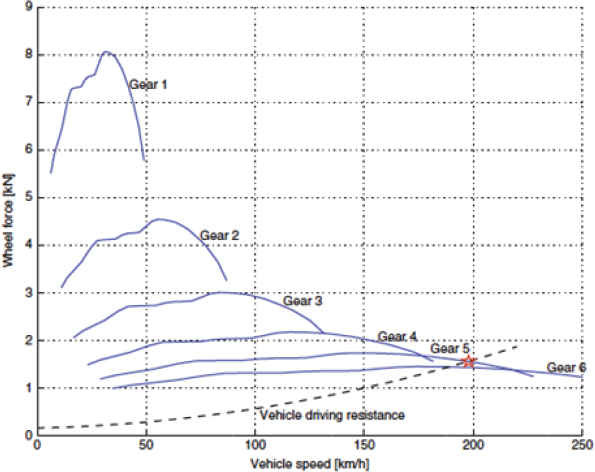
The basic question in is why transmission is required in an
automobile the power generated by the engine flows
through the transmission before it reaches the drive wheels         
the basic function of the transmission
is to control the speed and torque             
available to the drive wheels for
different driving conditions.


(TORQUE) X (SPEED) => POWER 

for example:, if you want to climb a hill
you need more torque by reducing the              
speed at the transmission we will be
able to achieve higher torque for the          
same power input.

(TORQUE)(high) X (SPEED)(reduced) => POWER (same)

Conversely, if the torque 
demand is low we can increase the transmission
 speed now let's look at its inner workings         
manual transmissions work on the simple
the principle of gear ratio
a basic transmission mechanism is          
that the input and output shafts are
connected through a countershaft
a three-speed mechanism will look like
it is clear that just by sliding the
gears we can achieve different transmission ratios          
this transmission is more specifically
called a sliding mesh transmission.


They are good for controlling the speed
but they have an inherent disadvantage
it's quite tricky to slide from one gear
and engage with another gear.


CONSTANT MESH TRANSMISSION

Image result for gif of manual transmission
  
                    
The constant mesh transmission
permanently solve this problem
here the gears are always in mesh, but
with a major difference here is that the output
gears are loosely connected to the shaft
if we connect only one gear to the shaft
at a time the shaft will have the speed of the
connected gear with the help of a
hypothetical connector different gear
ratios are illustrated here.
It is interesting to note that in fourth
gear the input and output shafts are         
directly connected.

The art of locking loosely held the gear to
the shaft effectively and smoothly lies
at the heart of the manual transmission 
let's see how this is done in actual
practice.


First of all the main shaft have a
synchronizer teeth arrangement.
Hub is fixed to the shaft
a sleeve that is free to slide     
the hub is also used in this system             
it is clear that if the sleeve gets cut              
with the teeth of the synchronizer cone
the gear and shaft will turn together or             
the desired locking action will be
achieved.
Related image


but during the gearbox operation the
shaft and gear will be rotating at
different speeds               
so such a locking action is not an easy
task a synchronizer rain helps to match the
speed of the gear with that of the shaft               
the synchronizer ring is capable of
rotating along with the hub but is free             
to slight actually         
before moving the sleeve the clutch
the pedal is pressed this way
power flow to the gear is discontinued


when we move the sleeve the sleeve will
press the synchronizer ring against the                
cone due to the high frictional force between
the synchronizer ring and cone the speed            
of the gear will become the same as the
shaft at this time the sleeve can be slated
further and it will get locked with the                 
gear.

Thus the gear gets locked with the shaft
in an efficient and smooth way, the same
mechanism is employed to shift
to other gears such as first gear second gear    
third gear and fourth gear.

You can also see the gear lever changing
mechanism a fifth gear is used to turn the output
shaft at a higher speed than the input shaft.


Now let's see how the reverse gear works
the reverse gear uses a gear arrangement as shown
out of those ones is the idle gear 
when the idle gear is pushed and
connected to the other two gears the  
output shaft will turn in the reverse
direction.

please note here that the reverse gear does not have a 
synchronizer ring mechanism this means that the 
gearbox rotation has to stop completely before applying the
reverse gear
======================================================

Thank you